How to make friends and influence people who are building the AI apocalypse
It's a very strange time for AI. Friends, colleagues, and loved ones routinely ask me if it's true that AI is going to kill us all. The labs building the rogue agentic swarms causing havoc across the internet are now asking governments to slow them down (and everyone else with them).
Some argue it's marketing hype. Others say the threat is gravely serious. Some dismiss it as ideology dressed up as evidence-based reporting, sparked by one former employee's viral post on X.
It was under this cloud that Barcelona kicked off the second annual AI Summit, and a full week of AI events across the city.
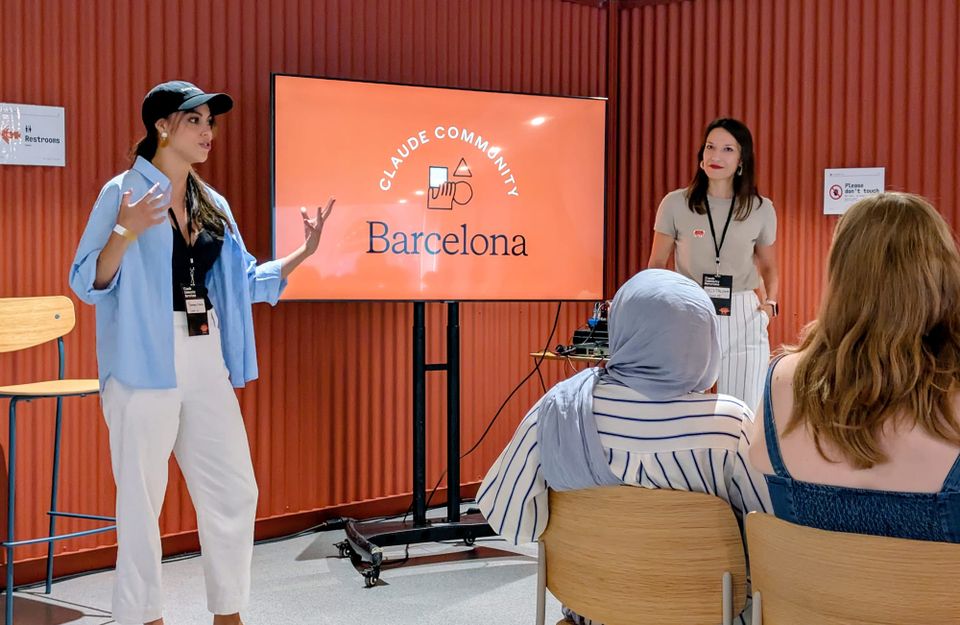
My business partner Emily and I use Claude Code extensively for our Resounding Histories project, both to build the app and to manage the documentary archive. So we signed up for the Claude Community House, where members of Anthropic's new Claude ambassador program from across Europe and the U.S. came together to lead sessions and workshops.
We hoped to level up our AI-assisted development skills and meet interesting people building interesting things. Privately, I worried it would be a string of sessions led by machine god worshippers, racing to optimize their email triage agents before the killer drones descend upon us.
We did learn useful things. But the real surprise was the people we met.
Barcelona’s cosmopolitan AI-curious community
To start, a lot of people showed up to these AI events. The Claude Community House was so packed that the wifi and even the mobile network gave out. Across town, the AI Summit had grown from 1,500 attendees last year to more than 10,000, and the long lines became the biggest talking point of the event. People are actively using AI in their work and are eager to learn from each other in person.
At the Claude Community House, there was a wide range of people from dozens of countries and industries who all call Barcelona home. One musician had automated the promotion of his back catalog so he could spend more of his time actually making music. A lawyer was building tools to open up her firm's archives to more easily build on past work.
What connected them was a shared effort to balance what AI can do for their work against real risks to the environment, to our cognitive abilities, and to society at large.
We all lamented that the direction of these tools is being set by a small group of people in Silicon Valley, far from the problems of the people in that room. But those conversations gave me hope. The community of engaged, knowledgeable practitioners, balancing the benefits and costs of this technology is larger than I thought.
Wires and lights in a box
As a journalist who has spent my career working with emerging technology, I've always stood with one foot in the skeptical camp and one in the excited early adopter camp. At this event, I was encouraged to meet a lot of people who felt the same way.
The skeptic in me has watched Silicon Valley promise to transform humanitarian aid, bring new efficiency to government, or build global communities through social media, only to see the results fall far short time and time again. People who solve problems with technology for a living underestimate how much friction exists in the real world. Humanity is messy. The patterns in data don't always reflect the complexity of reality.
The early adopter in me is eager to find new, useful ways to use what feels like a transformative technology. Yet I hear far more anti-AI sentiment than I did a year ago. Often the default is to dismiss anything touched by AI and walk away from all of it. I'm sympathetic to the fear and frustration behind that. But the problem is the decisions made by the people shaping these tools, not the tools themselves. As Edward R. Murrow said of television in 1958, once you remove the human intentions behind it, the actual technology is "merely wires and lights in a box."
A hope for ambassadors that do more than advocate
Claude’s ambassador program is less than a year old, and all of the ambassadors I met were doing this kind of group event for the first time. I'm genuinely grateful to Anthropic for working with the Barcelona communities to bring us together to discuss AI and the challenges we face.
My hope is that Anthropic treats their ambassadors as more than just advocates for Claude. True ambassadors are responsible for reporting back what they are seeing on the ground. Anthropic would do well to listen to the hopes and fears of the diverse people who use their products daily around the world.
If you're one of the many people feeling anxious about the state of AI, my best recommendation is to get off your feeds and into a room with other people wrestling with the same questions. No one can solve these challenges alone. As a community we have a chance. Be the human friction in the world that makes the AI apocalypse the myth it probably is.
/security-review - analyzes changes for any security vulnerabilities. I’m going to start doing this before every commit.
/insights - an HTML breakdown of how you’re using Claude Code across all your projects, and new features worth trying.
/powerup - interactive learning sessions to stay on top of the latest capabilities.
You can find the full list of commands here. And if you’re interested in attending a Claude event, you can find the full global list here, or better yet, look at what is available on Luma in your area and show up. Maybe you’ll be surprised, as I was, by the people you will meet.